Magnesium glycinate (often labeled bisglycinate) is the form with the strongest recent sleep trial behind it, but the benefit it showed was modest. In a 2025 randomized trial of 155 adults with poor sleep, 250 mg of elemental magnesium as bisglycinate lowered insomnia scores slightly more than placebo over four weeks, a difference that only just reached statistical significance1. It is a reasonable option to discuss with a pharmacist, not a proven sleep treatment.
This article is part of our magnesium for sleep guide.
Key takeaways
- Evidence strength: Limited. One good-sized placebo-controlled trial, with a small effect measured by questionnaire1.
- The trial: 155 adults, 250 mg elemental magnesium daily, 4 weeks. Insomnia score fell 3.9 points vs 2.3 with placebo1.
- Who might benefit more: an exploratory analysis hinted that people reporting low dietary magnesium improved more; this needs confirming1.
- Check the label: in the 2025 trial, each 893 mg capsule of magnesium bisglycinate provided 125 mg of elemental magnesium, about 14%1.
- Upper limit: 350 mg a day of supplemental magnesium for adults unless a clinician advises otherwise2.
What is magnesium glycinate?
Magnesium glycinate is magnesium bound to the amino acid glycine. “Bisglycinate” means each magnesium atom is bound to two glycine molecules; on supplement labels the two names are usually used for the same thing. Manufacturers call it a “chelate” because the glycine wraps around the magnesium.
Because glycine is relatively heavy, a capsule of magnesium glycinate contains much less magnesium than its total weight suggests. In the 2025 trial, each 893 mg capsule of magnesium bisglycinate contained 125 mg of elemental magnesium, about 14%1. So a product that says “500 mg magnesium glycinate” on the front may deliver only around 70 mg of actual magnesium. The Supplement Facts panel declares the elemental magnesium, so check that figure3.
What the 2025 trial found
The most relevant study is a randomized, double-blind, placebo-controlled trial published in Nature and Science of Sleep in 20251.
- Who: 155 adults aged 18–65 who reported poor sleep1.
- What: 250 mg of elemental magnesium as bisglycinate daily, or a placebo capsule1.
- How long: 4 weeks.
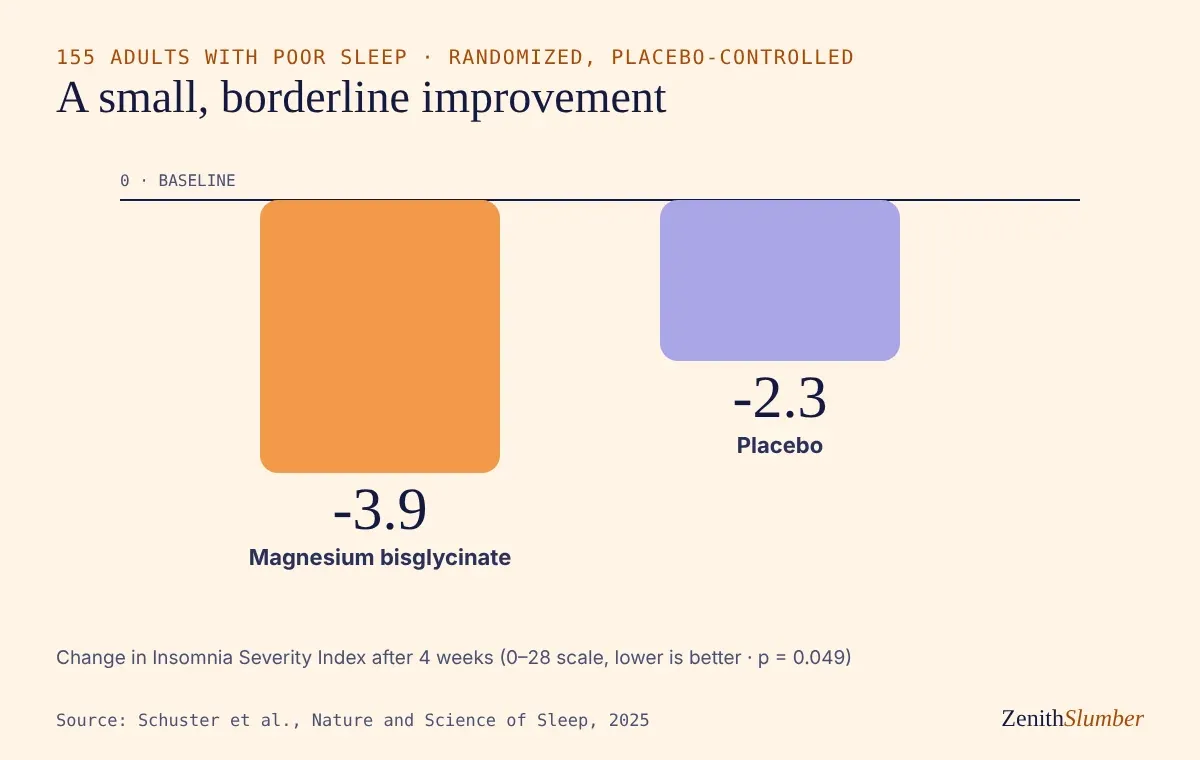
- Main result: the Insomnia Severity Index fell by 3.9 points in the magnesium group and 2.3 points in the placebo group, a small difference of 1.6 points that only just reached statistical significance (95% CI 0.0 to 3.3; p = 0.049)1.
- Subgroup signal: an exploratory analysis hinted at larger improvements in people reporting lower dietary magnesium, but intake was measured with a single unvalidated question1.
The authors’ own conclusion was that magnesium bisglycinate “modestly improved” insomnia severity, and they called for future studies with objective sleep measurements1.
Reading the result honestly
Two things stand out. First, the placebo group improved too, which is typical of sleep studies: simply paying attention to sleep and expecting help can make people feel better. Second, the extra benefit from magnesium, about 1.6 points on a 28-point scale, is small and only just reached statistical significance1. For chronic insomnia, the American Academy of Sleep Medicine strongly recommends cognitive behavioral therapy for insomnia (CBT-I)4.
Does the glycine matter?
Possibly, but nobody has tested it directly. Glycine has been studied on its own as a sleep aid. In one trial in volunteers with ongoing unsatisfactory sleep, 3 grams before bedtime improved subjective sleep quality and shortened the time to fall asleep on polysomnography12. Researchers at the Japanese company Ajinomoto, one of whom co-authored that trial, reported better subjective sleep quality after glycine in people with insomniac tendencies, and proposed that glycine works by lowering core body temperature, an idea based largely on rat studies5.
The 2025 trial’s daily dose supplied about 1.5 grams of glycine, roughly half the 3 grams used in glycine studies1. Because the trial had no glycine-only group, we can’t tell how much of the small benefit came from glycine; the authors suggest it may add to magnesium’s effect1.
Is glycinate better absorbed than other forms?
Forms of magnesium that dissolve well tend to be absorbed better. Citrate, lactate, aspartate and chloride generally outperform oxide and sulfate3. Magnesium oxide, for example, is about 60% elemental magnesium, but only around 4% of a dose is absorbed6.
Claims that glycinate is absorbed better than citrate, or that it is gentler on the stomach, are not well tested: the 2025 trial’s authors note that clinical evidence directly comparing the absorption of magnesium forms remains limited1. We treat these claims as plausible rather than proven.
| Form | Elemental magnesium (approx.) | What we know for sleep |
|---|---|---|
| Glycinate / bisglycinate | ~14% in the 2025 trial’s capsules1 | One 2025 RCT (university-funded): small benefit1 |
| Citrate | ~16%6 | Well absorbed3; one 7-week RCT in 100 adults aged 51–85 with poor sleep (320 mg/day; 96 completed): sleep quality improved in both the magnesium and placebo groups7 |
| L-threonate | ~7.5% (about 75 mg per gram in the trial product)8 | One small 21-day RCT funded by AIDP Inc.: no difference on the main insomnia score8 |
| Oxide | ~60%6 | Poorly absorbed (about 4%)6, yet used in the positive 2012 trial in older adults with insomnia (500 mg of elemental magnesium a day9, above the 350 mg upper limit for supplements2) |
Who might it suit?
Based on the evidence so far, magnesium glycinate is most worth discussing if:
- your diet is low in magnesium-rich foods such as nuts, seeds, legumes and whole grains (an unconfirmed hint from the 2025 trial)1;
- you have mild sleep complaints rather than long-standing insomnia;
- you have no kidney problems and no interacting medications (see below).
How much do studies use?
We don’t give personal dosing advice. For reference:
- The 2025 trial used 250 mg of elemental magnesium daily1.
- The adult upper limit for magnesium from supplements and medicines is 350 mg a day, unless a clinician advises otherwise2.
- Magnesium from food does not count toward that limit2.
If you decide to try it: what to check on the label
What to check on the label
- Evidence first: the evidence is Limited. One 4-week trial found a modest benefit on an insomnia questionnaire1. This is not a recommendation to take magnesium.
- Elemental magnesium per serving: use the elemental magnesium figure on the Supplement Facts panel, not the weight of the whole compound3. In the 2025 trial, an 893 mg capsule of bisglycinate held 125 mg of elemental magnesium1.
- A daily serving of 350 mg or less: that is the adult upper limit for magnesium from supplements and medicines combined, unless a clinician advises otherwise; some laxatives and heartburn or indigestion remedies also contain magnesium2. Check how many capsules make up one serving.
- The form name: “magnesium bisglycinate” (often just “glycinate”) is the form tested in the trial1. If the label lists several forms, for example glycinate with oxide, the product is a blend.
- An independent quality seal: organizations such as U.S. Pharmacopeia (USP), NSF International and ConsumerLab.com offer quality testing. Their seal means the product was properly manufactured, contains the ingredients on the label and has no harmful levels of contaminants, but a seal is not proof that a product is safe or effective11. The FDA does not approve dietary supplements before they are sold10.
- Safety before you buy: read who should be careful first, especially if you have kidney problems or take regular medicines.
Who should be careful
Who should be careful
- Kidney disease: don’t take magnesium supplements without medical advice3.
- Antibiotics (tetracyclines, quinolones) and osteoporosis drugs (bisphosphonates): magnesium can reduce their absorption. Separate doses as advised by your pharmacist3.
- Diuretics and long-term acid reducers (PPIs): these can change magnesium levels3.
- Pregnancy, breastfeeding and children: speak with a clinician first.
- Stomach upset or diarrhea: high intakes from supplements and medicines can cause diarrhea, nausea and abdominal cramping2.
The bottom line
Magnesium glycinate has the best recent trial evidence of any magnesium form for sleep, but the benefit was modest and measured over four weeks by questionnaire. It may suit people who don’t get enough magnesium from food, though that is not yet proven. Check the elemental magnesium on the label, stay within the 350 mg supplemental limit, and give food sources a try first; our guide to foods that help you sleep covers magnesium-rich options. For a wider look at the research, read our magnesium for sleep guide.
Frequently asked questions
Is magnesium bisglycinate the same as magnesium glycinate?
On most supplement labels, yes. Bisglycinate specifies two glycine molecules per magnesium atom, which is how glycinate supplements are usually made.
How long does magnesium glycinate take to work for sleep?
The main trial measured results after four weeks1. Don’t expect a sleeping-pill effect on the first night.
Can I take magnesium glycinate with melatonin?
There is little research on the combination. Melatonin is a hormone and is prescription-only in some countries, so check with a pharmacist.
Does magnesium glycinate cause diarrhea?
High intakes of magnesium from supplements can cause diarrhea2. Manufacturers say glycinate is gentler, but independent evidence is limited.
Sources (12)
- Schuster J, Cycelskij I, Lopresti A, Hahn A. Magnesium bisglycinate supplementation in healthy adults reporting poor sleep: a randomized, placebo-controlled trial. Nat Sci Sleep. 2025;17:2027–2040. https://pmc.ncbi.nlm.nih.gov/articles/PMC12412596/
- NIH Office of Dietary Supplements. Magnesium: Fact Sheet for Consumers. https://ods.od.nih.gov/factsheets/Magnesium-Consumer/
- NIH Office of Dietary Supplements. Magnesium: Fact Sheet for Health Professionals. https://ods.od.nih.gov/factsheets/Magnesium-HealthProfessional/
- Edinger JD, et al. Behavioral and psychological treatments for chronic insomnia disorder in adults: an American Academy of Sleep Medicine clinical practice guideline. J Clin Sleep Med. 2021;17(2):255–262. https://pubmed.ncbi.nlm.nih.gov/33164742/
- Bannai M, Kawai N. New therapeutic strategy for amino acid medicine: glycine improves the quality of sleep. J Pharmacol Sci. 2012;118(2):145–148. https://pubmed.ncbi.nlm.nih.gov/22293292/
- Ahmed F, Mohammed A. Magnesium: the forgotten electrolyte — a review on hypomagnesemia (Table 5). Med Sci (Basel). 2019;7(4):56. https://pmc.ncbi.nlm.nih.gov/articles/PMC6524065/
- Nielsen FH, et al. Magnesium supplementation improves indicators of low magnesium status and inflammatory stress in adults older than 51 years with poor quality sleep. Magnes Res. 2010;23(4):158–168. https://pubmed.ncbi.nlm.nih.gov/21199787/
- Hausenblas HA, et al. Magnesium-L-threonate improves sleep quality and daytime functioning in adults with self-reported sleep problems: a randomized controlled trial. Sleep Med X. 2024;8:100121. https://pubmed.ncbi.nlm.nih.gov/39252819/
- Abbasi B, et al. The effect of magnesium supplementation on primary insomnia in elderly: a double-blind placebo-controlled clinical trial. J Res Med Sci. 2012;17(12):1161–1169. https://pmc.ncbi.nlm.nih.gov/articles/PMC3703169/
- U.S. Food and Drug Administration. Questions and answers on dietary supplements. https://www.fda.gov/food/information-consumers-using-dietary-supplements/questions-and-answers-dietary-supplements
- NIH Office of Dietary Supplements. Dietary Supplements: What You Need to Know. NIH Publication No. 20-OD-8115, March 2020. https://ods.od.nih.gov/pubs/DS_WhatYouNeedToKnow.pdf · Web version: https://ods.od.nih.gov/factsheets/WYNTK-Consumer/
- Yamadera W, Inagawa K, Chiba S, Bannai M, Takahashi M, Nakayama K. Glycine ingestion improves subjective sleep quality in human volunteers, correlating with polysomnographic changes. Sleep Biol Rhythms. 2007;5(2):126–131. https://doi.org/10.1111/j.1479-8425.2007.00262.x