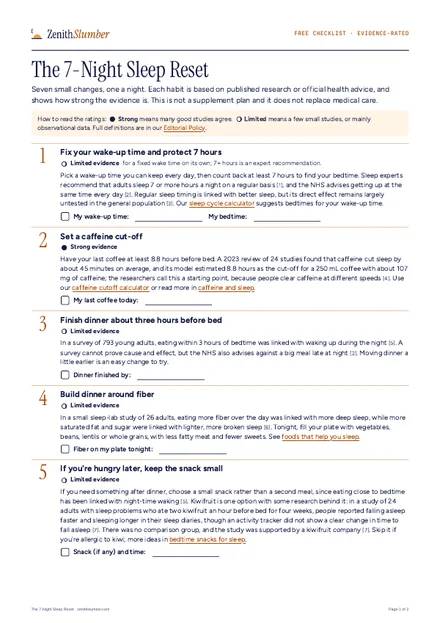
If you’re genuinely hungry before bed, a small snack is fine, and a few choices may even help. Two kiwis an hour before bed improved sleep in a small, uncontrolled study1, tart cherry juice concentrate raised melatonin levels and sleep time in another2, and magnesium-rich options such as pumpkin seeds and almonds help fill a common nutrient gap3. Timing matters too: eating within a few hours of bedtime has been linked with more night-time waking410.
This article is part of our foods that help you sleep guide.
Key takeaways
- Evidence strength: Limited. Two small studies back specific snacks; keeping snacks small, low in sugar and well before bed is the safer bet.
- Best-supported picks: kiwifruit1 and tart cherry juice2, each with one small trial. Magnesium-rich nuts and seeds are nutritious, but trials of magnesium for sleep have had mixed results39.
- Keep it small: finishing the last meal within 3 hours of bed was linked with more awakenings in a student survey4; that survey measured meal timing, so it can’t tell us whether a small snack has the same effect.
- Skip: anything with caffeine, including chocolate6. Go easy on sugary and fatty foods: in a small lab study, diets higher in sugar and saturated fat were linked with lighter, more broken sleep5.
- Timing: in a large U.S. survey, long spells awake at night became less likely the longer people left between eating and bed10.
What makes a good bedtime snack?
- Small: enough to take the edge off hunger, not a second dinner.
- Some fiber: higher fiber intake across the day was linked with more deep sleep in a small lab study5.
- Low in added sugar: in the same study, a higher share of calories from sugar was linked with more brief arousals during the night5.
- Caffeine-free: caffeine reduced total sleep by about 45 minutes on average across 24 studies7.
- Easy on your stomach: if you’re prone to heartburn, avoid large, rich or spicy foods late at night.
8 bedtime snacks worth trying
| Snack | Why it may help | Evidence |
|---|---|---|
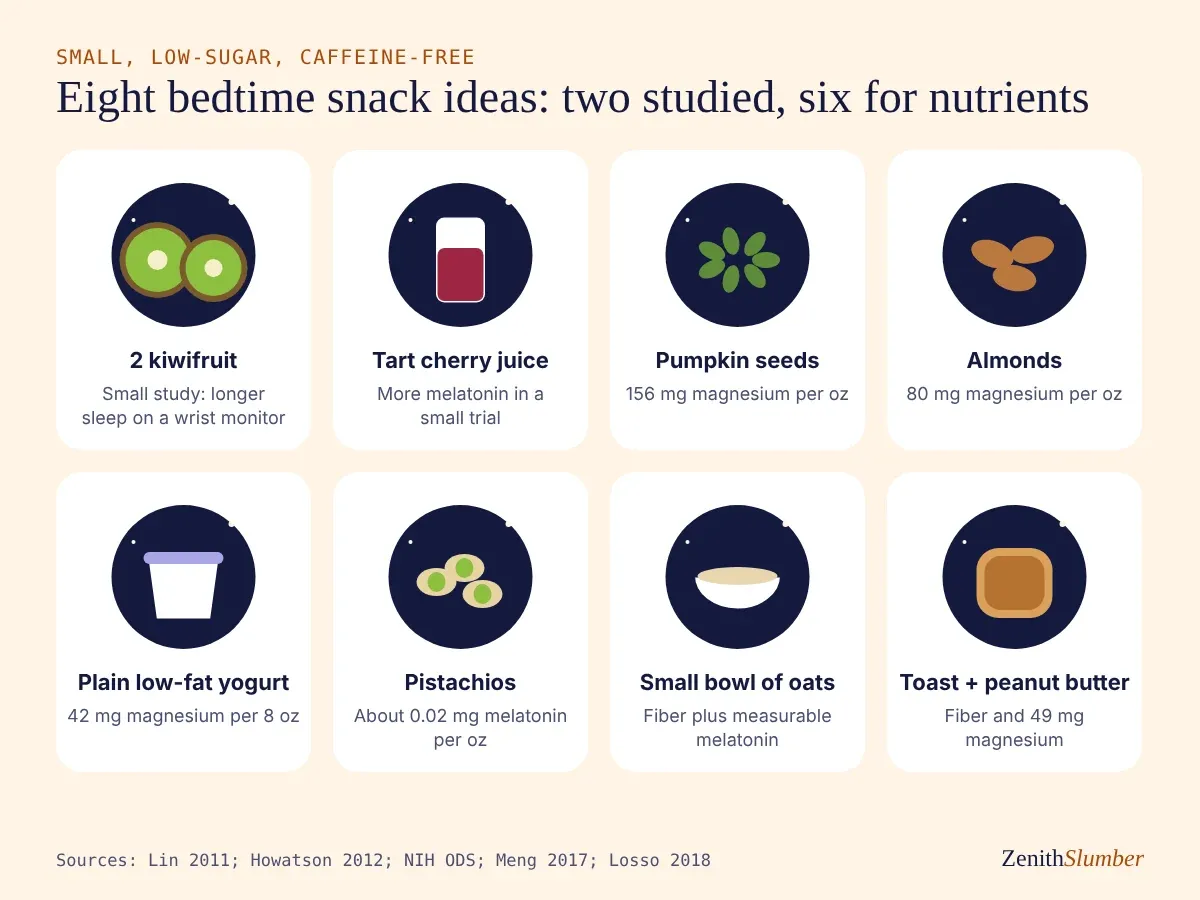
| 2 kiwifruit | In sleep diaries, adults with sleep problems fell asleep 35% faster after 4 weeks; a wrist monitor showed longer sleep but no significant change in time to fall asleep1 | Small, uncontrolled study; funded by a kiwifruit company1 |
| Tart cherry juice | Concentrate raised urinary melatonin and improved sleep time in a placebo-controlled trial of 20 healthy adults2 | Small trial; concentrate donated by a juice company2; contains natural sugar |
| Small handful of pumpkin seeds | 156 mg of magnesium per ounce3 | Indirect (magnesium) |
| Small handful of almonds | 80 mg of magnesium per ounce3 | Indirect (magnesium) |
| Plain low-fat yogurt | 42 mg of magnesium per 8 oz, plus protein3 | Indirect |
| Small handful of pistachios | Contain melatonin: about 660 ng per gram in an analysis done for American Pistachio Growers, so a 28 g handful provides roughly 0.02 mg11; see our guide to foods high in melatonin | Indirect; one industry analysis |
| Small bowl of oats | Fiber plus measurable melatonin8 | Indirect |
| Whole-grain toast with peanut butter | Fiber and 49 mg of magnesium per 2 tbsp of peanut butter3 | Indirect |
Kiwifruit
The most specific snack study: 24 adults with sleep problems ate two kiwis an hour before bed every night for four weeks. In their sleep diaries, time to fall asleep dropped by about 35%. A wrist activity monitor showed about 55 minutes more total sleep and better sleep efficiency, but no significant change in time to fall asleep1. There was no control group and the study was funded by a kiwifruit company1, so treat it as a promising lead rather than proof.
Tart cherry juice
In a placebo-controlled crossover trial in 20 healthy adults, a week of tart cherry juice concentrate increased urinary melatonin and improved total sleep time and sleep efficiency2. The concentrate was donated by a juice company2, and how much ordinary juice would match it isn’t established. Juice is also high in natural sugar.
Magnesium-rich nuts, seeds and yogurt
Nearly half of Americans don’t get enough magnesium from food3. Observational studies link better magnesium status with better sleep, though supplement trials have had mixed results9. A small handful of pumpkin seeds, almonds or cashews, or a cup (8 oz) of plain low-fat yogurt (about 42 mg)3, adds magnesium without a big meal. Read more in our magnesium for sleep guide.
Oats and whole grains
Cereals such as oats and wheat contain measurable melatonin8, and whole grains add fiber. A small bowl of oats with a few seeds is a filling, low-sugar option.
Snacks to skip before bed
- Chocolate: it naturally contains caffeine6.
- Coffee, cola, energy drinks and caffeinated tea: caffeine can disrupt sleep for many hours7. See caffeine and sleep.
- Ice cream, cookies and sweets: in a small lab study, days with a higher share of calories from sugar were linked with more brief arousals during the night5. Bedtime sweets weren’t tested specifically.
- Heavy, fatty foods: more saturated fat across the day was linked with less deep sleep in the same study5, and a full stomach can worsen reflux.
How late is too late?
There is no exact rule, but two studies offer guidance:
- In a survey of 793 university students, finishing the last meal within three hours of bedtime was linked with higher odds of waking at night4.
- In a large U.S. time-use survey, eating or drinking within an hour of bed was linked with longer total sleep but higher odds of a long spell awake during the night. The odds were also raised for eating within two or three hours of bed and fell as the gap widened10.
Neither study looked at how much people ate410. A practical approach: finish dinner about three hours before bed, and if you need a snack later, keep it small and have it as early as practical.
Who should be careful
Who should be careful
- Diabetes: juice and starchy snacks affect blood sugar. Ask your care team about evening snacks, especially if you take insulin or medicines that can cause low blood sugar.
- Reflux or heartburn: avoid lying down soon after eating.
- Allergies: nuts, seeds and kiwi are common allergens.
- Weight goals: nuts are nutritious but calorie-dense; a small handful is about 1 oz (28 g).
- Poor sleep that lasts: if sleep problems go on for more than a few weeks, talk to a doctor rather than relying on food changes.
The bottom line
The best bedtime snack is a small, low-sugar, caffeine-free one eaten as early in the evening as practical. Kiwis and tart cherry juice have small studies behind them; magnesium-rich nuts, seeds and yogurt are nutritious choices with only indirect evidence. None of them replaces good sleep habits, but they can replace the cookies.
Frequently asked questions
Is it bad to eat right before bed?
Eating or drinking within a few hours of bed has been linked with more night-time waking in survey data, though these studies didn’t record how much people ate410. If you need something, a small snack eaten as early as practical is the cautious choice.
What should I eat if I wake up hungry at night?
Something small and plain, such as a few almonds or a little yogurt. If it happens often, consider whether your dinner is too small or too early.
Are bananas a good bedtime snack?
They’re an easy, low-fat snack, but we didn’t find sleep trials specifically on bananas.
Does honey help you sleep?
Honey is often recommended, but we found no good-quality sleep studies on it. It’s also mostly sugar, and in a small lab study a higher share of calories from sugar was linked with more night-time arousals5.
Sources (11)
- Lin HH, et al. Effect of kiwifruit consumption on sleep quality in adults with sleep problems. Asia Pac J Clin Nutr. 2011;20(2):169–174 (Tables 2–3; supported by Zespri International). https://pubmed.ncbi.nlm.nih.gov/21669584/
- Howatson G, et al. Effect of tart cherry juice (Prunus cerasus) on melatonin levels and enhanced sleep quality. Eur J Nutr. 2012;51(8):909–916. https://pubmed.ncbi.nlm.nih.gov/22038497/
- NIH Office of Dietary Supplements. Magnesium: Fact Sheet for Health Professionals. https://ods.od.nih.gov/factsheets/Magnesium-HealthProfessional/
- Chung N, et al. Does the proximity of meals to bedtime influence the sleep of young adults? A cross-sectional survey of university students. Int J Environ Res Public Health. 2020;17(8):2677. https://doi.org/10.3390/ijerph17082677
- St-Onge MP, et al. Fiber and saturated fat are associated with sleep arousals and slow wave sleep. J Clin Sleep Med. 2016;12(1):19–24. https://pmc.ncbi.nlm.nih.gov/articles/PMC4702189/
- U.S. Food and Drug Administration. Spilling the beans: how much caffeine is too much? https://www.fda.gov/consumers/consumer-updates/spilling-beans-how-much-caffeine-too-much
- Gardiner C, et al. The effect of caffeine on subsequent sleep: a systematic review and meta-analysis. Sleep Med Rev. 2023;69:101764. https://doi.org/10.1016/j.smrv.2023.101764
- Meng X, et al. Dietary sources and bioactivities of melatonin. Nutrients. 2017;9(4):367. https://pmc.ncbi.nlm.nih.gov/articles/PMC5409706/
- Arab A, et al. The role of magnesium in sleep health: a systematic review of available literature. Biol Trace Elem Res. 2023;201(1):121–128. https://pubmed.ncbi.nlm.nih.gov/35184264/
- Iao SI, et al. Associations between bedtime eating or drinking, sleep duration and wake after sleep onset. Br J Nutr. 2022;127(12):1888–1897. https://pubmed.ncbi.nlm.nih.gov/34511160/
- Losso JN. Melatonin contents of raw and roasted American pistachios. Report to American Pistachio Growers, Louisiana State University, 27 November 2018. https://americanpistachios.org/sites/default/files/inline-files/Jack%20Losso_%20%20Report%20to%20American%20Pistachio%20Growers_0.pdf