No single food will knock you out, but what and when you eat can nudge your sleep in either direction. A handful of small studies suggest that kiwifruit and tart cherry juice may help some people sleep12, and a trial of fatty fish found better daytime functioning, though not clearly better sleep3. The bigger picture matters too: in a sleep-lab study, eating more fiber was linked with more deep sleep, while more saturated fat and sugar were linked with lighter, more broken sleep4.
Key takeaways
- Evidence strength: Limited. Small studies hint at benefits from kiwifruit and tart cherries, but no single food is proven to improve sleep; overall diet quality and meal timing are also linked with how well people sleep.
- Foods with sleep studies behind them: kiwifruit1, tart cherry juice25 and fatty fish such as salmon3, each backed by only one or two small trials. Several of these trials were supported by the food industry.
- Diet quality matters: more fiber was linked with deeper sleep; more saturated fat and sugar with lighter, more disrupted sleep4.
- Timing matters: eating within 3 hours of bedtime was linked with higher odds of waking at night in a survey of 793 university students6.
- Biggest food-related sleep thief: caffeine. A meta-analysis estimated that, on average, a cup of coffee (about 107 mg of caffeine) is best kept at least 8.8 hours before bed7.
What food research can and can’t tell us
Food studies are hard to run. You can’t make a “placebo kiwi”, many studies last only a few weeks, and some are funded by the food industry. So in this guide we separate three levels of evidence:
- Controlled trials that changed what people ate and measured sleep.
- Lab studies that measured sleep carefully in small groups.
- Surveys and observational studies, which show associations but can’t prove cause and effect.
We tell you which kind of evidence sits behind each food, and who funded it.
Foods with the most evidence
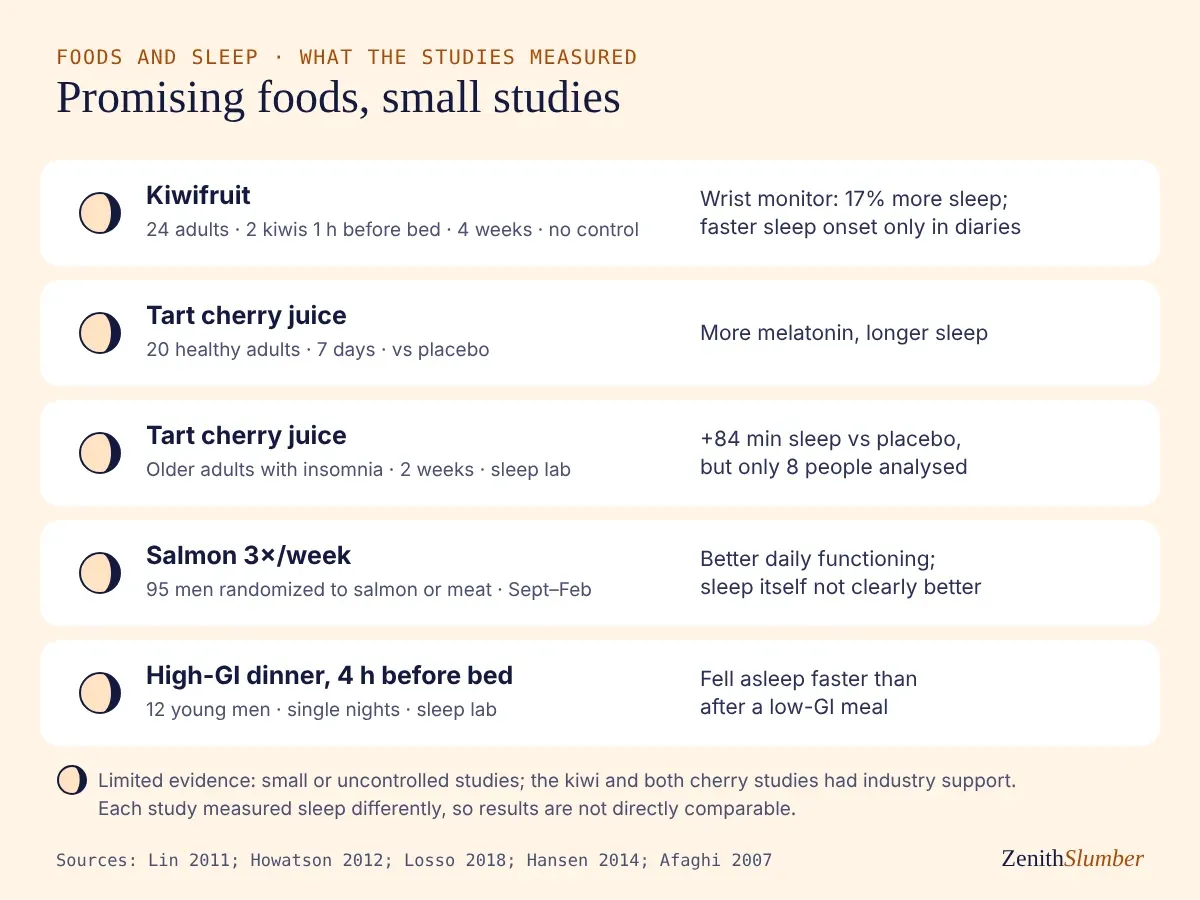
| Food | What was studied | What happened | Evidence |
|---|---|---|---|
| Kiwifruit | 24 adults with sleep problems ate 2 kiwis 1 hour before bed for 4 weeks1 | Sleep diaries: fell asleep 35% faster. Wrist monitor: total sleep up 17%, but no significant change in time to fall asleep1 | Limited (no control group; supported by Zespri, a kiwifruit company1) |
| Tart cherry juice | 20 healthy adults drank tart cherry concentrate for 7 days vs placebo2 | Higher urinary melatonin, longer total sleep time and better sleep efficiency2 | Limited (juice concentrate donated by CherryActive2) |
| Tart cherry juice (older adults with insomnia) | Juice twice daily for 2 weeks vs placebo, measured in a sleep lab5 | 84 minutes more total sleep than placebo, but only 8 people were analysed5 | Limited (supported by the Cherry Marketing Institute5) |
| Fatty fish (salmon) | 95 men randomized to salmon or other meat 3 times a week, September to February3 | Better self-rated daily functioning; time to fall asleep lengthened in the meat group but not the fish group3 | Limited |
| High-GI carbohydrate dinner | 12 young men ate jasmine rice vs low-GI rice 4 hours before bed8 | Fell asleep faster after the high-GI meal (9 vs 17.5 minutes)8 | Limited (one small study) |
| Magnesium-rich foods | Observational studies and supplement trials9 | Better magnesium status is linked with better sleep; supplement trials have had mixed, inconclusive results9 | Limited |
Kiwifruit
In a 2011 study, 24 adults with sleep problems ate two kiwis an hour before bed every night for four weeks. In their sleep diaries, time to fall asleep dropped by 35% and time awake during the night by 29%. A wrist activity monitor confirmed longer total sleep (up 17%) and better sleep efficiency, but no significant change in time to fall asleep1. The researchers point to kiwi’s antioxidants, serotonin and folate as possible reasons1. The catch: there was no comparison group, so we can’t rule out the effect of simply paying attention to bedtime habits, and the study was supported by a kiwifruit company1.
Tart cherries
Montmorency tart cherries contain melatonin, and in a placebo-controlled trial in 20 healthy adults, a week of tart cherry juice concentrate raised urinary melatonin levels and improved total sleep time and sleep efficiency; a juice company donated the concentrate2. A small sleep-lab study in older adults with insomnia found 84 minutes more sleep with the juice than with placebo, but only 8 people were analysed and the trial was supported by the Cherry Marketing Institute5. Promising, not proven. Tart cherry juice is also high in natural sugar, which matters if you’re watching your intake.
Fatty fish
In a study that ran from September to February, 95 men were randomized to eat Atlantic salmon or chicken, pork or beef three times a week. The fish group rated their daily functioning better, and their time to fall asleep did not lengthen over the winter as it did in the meat group, but other sleep measures did not improve3. The participants were male patients in a secure forensic inpatient facility, so the results may not apply to everyone3. The study was funded by the University of Bergen and Haukeland University Hospital in Norway; Skretting ARC provided the farmed salmon3. Oily fish is still a healthy choice; just don’t expect it to work as a sleep aid.
Carbohydrates, timed well
In a small lab study of 12 healthy young men, a high-glycemic rice dinner eaten four hours before bed shortened the time to fall asleep compared with a low-glycemic rice dinner. The same meal eaten one hour before bed was less effective8. This doesn’t mean you should eat sugary food at night; it suggests a carbohydrate-containing dinner a few hours before bed is fine for sleep.
Look at your overall diet, not single foods
The most useful finding comes not from a “superfood” but from diet quality. In a sleep-lab study, 26 adults had their sleep measured after days of controlled meals and after a day of eating whatever they chose4:
- More fiber predicted more deep (slow-wave) sleep4.
- More saturated fat predicted less deep sleep4.
- More sugar was associated with more arousals during the night4.
- After the self-chosen day, people took longer to fall asleep and had less deep sleep than after the controlled meals4.
This was a short study in which food choices were measured over a single day, so it shows links rather than proof4. The practical takeaway: a dinner built around vegetables, legumes, whole grains and lean protein, with less fatty meat and fewer sweets, is a sensible default for sleep as well as health.
When you eat matters too
- Leave some time before bed. In a survey of 793 university students, eating within three hours of bedtime was linked with higher odds of waking during the night6.
- Late snacks and broken sleep: in a large U.S. time-use survey, people who ate or drank within an hour of bed slept longer on weekdays but were more likely to spend a long time awake during the night, and those odds fell as the gap before bed widened10.
Neither study can prove cause and effect, but together they support a simple habit: aim to finish your main meal about three hours before bed, and if you’re hungry later, keep it small. If you’re not sure when your bedtime should be, our sleep cycle calculator can help you plan the evening backwards. Our bedtime snacks guide has ideas for later in the evening.
What to limit in the evening
- Caffeine. A meta-analysis of 24 studies found caffeine cut total sleep by about 45 minutes on average7. Coffee, strong tea, cola, energy drinks and some chocolate all contain it. See our guide to caffeine and sleep.
- Heavy, fatty late meals. Saturated fat across the day was linked with less deep sleep4, and eating late with more night waking6; a heavy, fatty late meal combines both, although no study has tested it directly.
- Lots of sugar. Diets higher in sugar were linked with more night-time arousals4.
A simple sleep-friendly evening plate
- Base: brown rice, potatoes or whole-grain bread.
- Protein: salmon or another oily fish twice a week; beans or lentils on other days.
- Vegetables: a generous serving, ideally including leafy greens like spinach, a good source of magnesium12.
- Optional later snack: two kiwis, a small handful of pumpkin seeds or a pot of plain yogurt.
Who should be careful
Who should be careful
- Diabetes: tart cherry juice and high-glycemic meals raise blood sugar. Talk to your care team before changing evening carbohydrates.
- Heartburn or reflux: large or late meals can make symptoms worse; eating earlier may help.
- Food allergies: kiwi is a common allergen.
- Insomnia that lasts: food changes can help at the edges, but long-standing insomnia deserves a conversation with a doctor.
The bottom line
Kiwifruit and tart cherries have a few small, partly industry-supported studies behind them, and fatty fish has not clearly improved sleep itself. None of this evidence is strong. The most reliable food strategy for better sleep is boring and effective: more fiber, less saturated fat and sugar, dinner about three hours before bed, and no caffeine in the afternoon. For more detail, read our guides to foods high in melatonin and magnesium for sleep, including which form of magnesium has been tested.
Frequently asked questions
What is the best food to eat before bed?
There is no single best food. Kiwifruit has one small, uncontrolled study behind it1, and a light snack that includes fiber and a little protein is a sensible choice.
Does warm milk help you sleep?
The evidence is thin. In elderly care-home residents, melatonin-rich night-time milk worked no better than ordinary milk on caregiver-rated sleep11; good trials of warm milk itself are lacking. Many people still find a warm drink relaxing as part of a routine.
Should I avoid carbohydrates at night?
Not necessarily. In one small study of 12 healthy young men, a high-GI rice dinner eaten four hours before bed shortened the time to fall asleep compared with a low-GI rice dinner (9 vs 17.5 minutes)8.
How long before bed should I stop eating?
About three hours for a main meal is a reasonable target: survey data link eating within three hours of bedtime with more night waking6, and in U.S. data the odds fell as the gap widened10. Studies haven’t pinned down an exact cut-off.
Sources (12)
- Lin HH, et al. Effect of kiwifruit consumption on sleep quality in adults with sleep problems. Asia Pac J Clin Nutr. 2011;20(2):169–174 (Tables 2–3; supported by Zespri International). https://pubmed.ncbi.nlm.nih.gov/21669584/
- Howatson G, et al. Effect of tart cherry juice (Prunus cerasus) on melatonin levels and enhanced sleep quality. Eur J Nutr. 2012;51(8):909–916. https://pubmed.ncbi.nlm.nih.gov/22038497/
- Hansen AL, et al. Fish consumption, sleep, daily functioning, and heart rate variability. J Clin Sleep Med. 2014;10(5):567–575. https://pmc.ncbi.nlm.nih.gov/articles/PMC4013386/
- St-Onge MP, et al. Fiber and saturated fat are associated with sleep arousals and slow wave sleep. J Clin Sleep Med. 2016;12(1):19–24. https://pubmed.ncbi.nlm.nih.gov/26156950/
- Losso JN, et al. Pilot study of the tart cherry juice for the treatment of insomnia and investigation of mechanisms. Am J Ther. 2018;25(2):e194–e201. https://pmc.ncbi.nlm.nih.gov/articles/PMC5617749/
- Chung N, et al. Does the proximity of meals to bedtime influence the sleep of young adults? A cross-sectional survey of university students. Int J Environ Res Public Health. 2020;17(8):2677. https://doi.org/10.3390/ijerph17082677
- Gardiner C, et al. The effect of caffeine on subsequent sleep: a systematic review and meta-analysis. Sleep Med Rev. 2023;69:101764. https://doi.org/10.1016/j.smrv.2023.101764
- Afaghi A, et al. High-glycemic-index carbohydrate meals shorten sleep onset. Am J Clin Nutr. 2007;85(2):426–430. https://pubmed.ncbi.nlm.nih.gov/17284739/
- Arab A, et al. The role of magnesium in sleep health: a systematic review of available literature. Biol Trace Elem Res. 2023;201(1):121–128. https://pubmed.ncbi.nlm.nih.gov/35184264/
- Iao SI, et al. Associations between bedtime eating or drinking, sleep duration and wake after sleep onset. Br J Nutr. 2022;127(12):1888–1897. https://pubmed.ncbi.nlm.nih.gov/34511160/
- Valtonen M, et al. Effect of melatonin-rich night-time milk on sleep and activity in elderly institutionalized subjects. Nord J Psychiatry. 2005;59(3):217–221. https://pubmed.ncbi.nlm.nih.gov/16195124/
- NIH Office of Dietary Supplements. Magnesium: Fact Sheet for Health Professionals. https://ods.od.nih.gov/factsheets/Magnesium-HealthProfessional/