Melatonin is found in many everyday foods, including pistachios, cereals such as oats and wheat, tart cherries, fish and eggs1. But the amounts are tiny compared with a supplement, and they vary enormously from one sample and lab method to the next. An analysis done at Louisiana State University in partnership with American Pistachio Growers measured about 660 nanograms of melatonin per gram in both raw and roasted pistachios25; at that level, a 28 g handful would provide roughly 0.02 mg, a small fraction of the doses used in insomnia studies4. Some food melatonin does seem to be absorbed: in one trial, a week of tart cherry juice raised the melatonin breakdown products found in urine3.
This article is part of our foods that help you sleep guide.
Key takeaways
- Evidence strength: Limited. Food melatonin is real and measurable, but studies linking it directly to better sleep are few and small.
- Higher-melatonin foods: pistachios25, some corn and rice varieties1, and wheat, oats and barley in one analysis, though other analyses found far less1. Tart cherries contain much less but have been tested for sleep13.
- Huge variation: corn varieties ranged from 10 to 2,034 ng per gram of dry weight in one analysis1.
- Scale check: by the industry analysis, a handful of pistachios provides about 0.02 mg of melatonin5, while insomnia studies have used 0.5 to 5 mg a day4.
- Does it work? Tart cherry juice raised melatonin levels and improved sleep in a small trial3, but researchers think other compounds in the juice may matter more4.
Why is melatonin in food at all?
Melatonin was long thought to be made only by the pineal gland in animals, but it has since been found in plants, insects, fungi and bacteria1. Because it is so widespread, almost everyone eats a little melatonin every day without knowing it.
How much melatonin is in common foods?
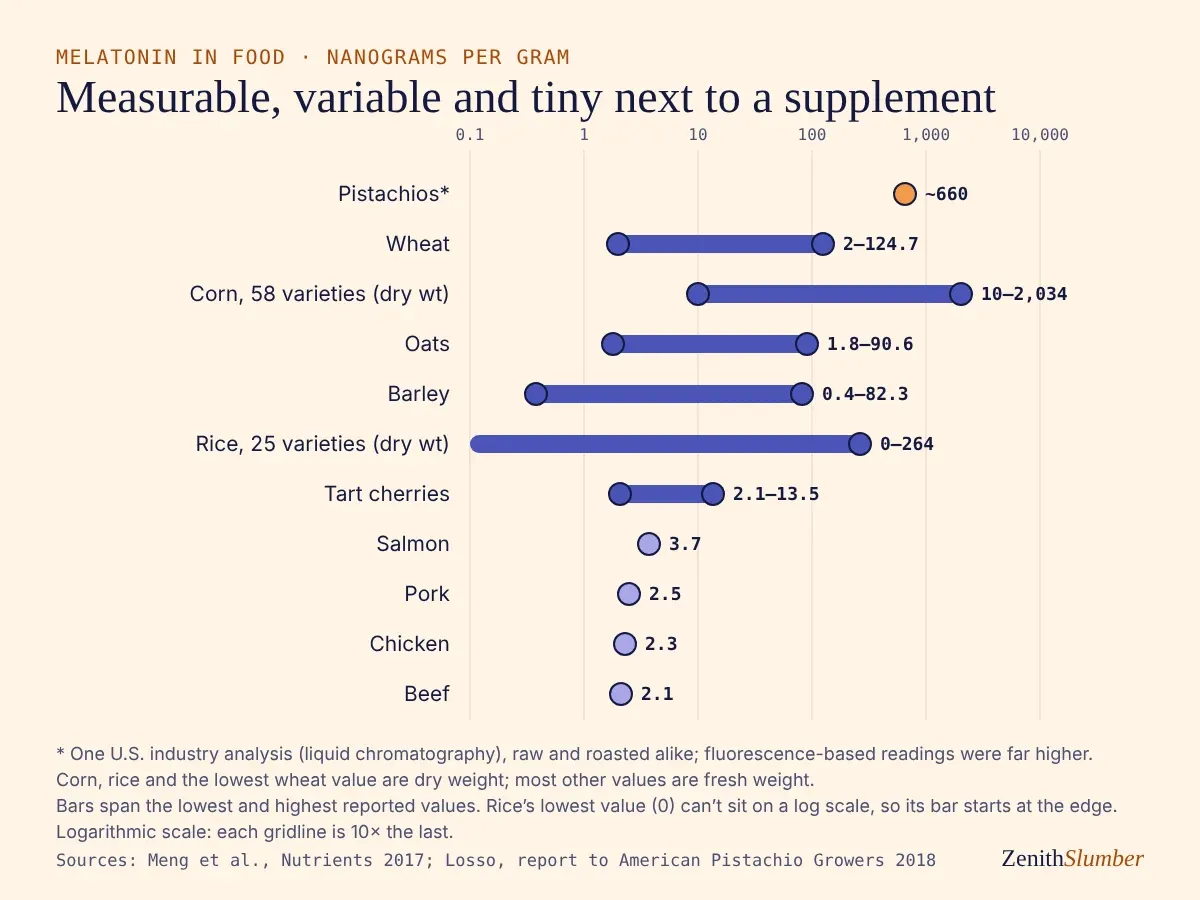
The table below uses values from published analyses. Read the numbers as rough guides: results depend on the variety, growing conditions, processing and the lab method used, and some values are per gram of fresh food while others are per gram of dried food (dry weight), which makes them look higher.
| Food | Melatonin (ng per gram) | Notes |
|---|---|---|
| Pistachios | ~660 | One U.S. analysis done in partnership with American Pistachio Growers, using liquid chromatography; raw 660, roasted 65625 |
| Wheat | 2–124.7 | Two analyses: the low value is purple wheat measured per gram of dry weight, the high value one analysis of fresh grain1 |
| Oats | 1.8–90.6 | Two analyses of fresh grain using different methods1 |
| Barley | 0.4–82.3 | Three analyses of fresh grain; the high value comes from the same analysis as the high wheat and oat values1 |
| Corn (58 varieties) | 10–2,034 (average 96.5) | Dry weight, one analysis; other corn samples measured about 1–2 ng/g1 |
| Rice (25 varieties) | 0–264 (average 16) | Dry weight, one analysis1 |
| Tart cherries | 2.1–13.5 | Fresh fruit; Montmorency and Balaton varieties1 |
| Salmon | 3.7 | 1 |
| Pork | 2.5 | 1 |
| Chicken (meat and skin) | 2.3 | 1 |
| Beef | 2.1 | 1 |
The review we draw on notes that measurements made with mass spectrometry (GC-MS or HPLC-MS) are more accurate than those made with other methods1. Its only mass-spectrometry measurement of barley found 0.87 ng/g, nearly 100 times less than the high value1.
A word on pistachios
Pistachios are often called the highest-melatonin food. The figure used in U.S. industry marketing, about 660 ng/g, comes from an analysis done at Louisiana State University in partnership with American Pistachio Growers2. Its report to the growers’ association, posted on the association’s website rather than published in a peer-reviewed journal, found 660 ng/g in raw and 656 ng/g in roasted pistachios using liquid chromatography (UHPLC), and says the two results are not statistically different5.
The same samples tested with a fluorescence method gave readings of 34 to 128 micrograms per gram, roughly 50 to 200 times higher, but the report notes that roasting may have increased fluorescent compounds and that the high readings may reflect that5. That fluorescence method came from a 2014 Iranian study, which reported values up to 233,000 ng per gram of dry weight15; its journal later published an expression of concern about that paper6. Pistachios are a nutritious snack, but the melatonin headline should be taken with caution.
Putting the numbers in perspective
Food melatonin is measured in nanograms, while supplements are measured in milligrams. One milligram is a million nanograms.
| Source | Approximate melatonin |
|---|---|
| 28 g (1 oz) pistachios at ~660 ng/g | ~0.018 mg (our calculation from5) |
| 40 g oats at 1.8–90.6 ng/g | ~0.00007–0.004 mg (our calculation from1) |
| 100 g salmon at 3.7 ng/g | ~0.0004 mg (our calculation from1) |
| Melatonin doses used in insomnia studies | 0.5–5 mg a day4 |
Even a generous food serving provides far less melatonin than the doses studied for sleep. Only fluorescence-based pistachio readings, the method behind the disputed 2014 figure, would put a handful of nuts at or above those doses156. That doesn’t make these foods useless: they come with fiber, minerals and other compounds that may matter as much as the melatonin itself.
Does eating melatonin-rich food help you sleep?
There is some evidence that food melatonin is absorbed. In a placebo-controlled trial, 20 healthy adults drank tart cherry juice concentrate for seven days; the melatonin breakdown products in their urine rose, and they slept longer and more efficiently3. The concentrate was donated by a juice company, CherryActive3.
But it is hard to credit melatonin alone. The researchers behind a later trial in older adults with insomnia, supported by the Cherry Marketing Institute, estimated that the concentrate used in the trial above added only about 85 micrograms of melatonin a day, far below the 0.5 to 5 mg doses used in insomnia studies4. In lab tests, a compound in the juice, procyanidin B-2, blocked an enzyme that breaks down tryptophan, the building block for serotonin and melatonin, which the researchers suggest may partly explain the effect4. Kiwifruit, another food with a sleep study behind it, was chosen for its antioxidants, serotonin and folate, and that trial, supported by a kiwifruit company, did not discuss melatonin7.
So the honest answer: eating melatonin-containing foods is harmless and may help a little, but it won’t work like a melatonin pill, and the studies are small.
Easy ways to include these foods in the evening
- A small handful of pistachios or walnuts as an evening snack.
- A bowl of oats with a sprinkle of seeds.
- Salmon or another oily fish at dinner a couple of times a week.
- A glass of tart cherry juice, keeping in mind its natural sugar.
For more evening ideas, see our bedtime snacks guide.
Who should be careful
Who should be careful
- Melatonin supplements are a different matter. They are a hormone, are prescription-only in some countries and can interact with medications. Speak with a pharmacist before taking them.
- Diabetes: fruit juices such as tart cherry juice raise blood sugar.
- Nut allergies: pistachios and walnuts are common allergens.
The bottom line
Many foods contain melatonin, with pistachios and some corn and rice varieties near the top of published analyses. But the amounts are a tiny fraction of the doses used in sleep studies and vary widely between samples and lab methods. Choose these foods because they are part of a healthy, fiber-rich evening routine, not because you expect a sleeping-pill effect.
Frequently asked questions
Which food has the most melatonin?
In published analyses, pistachios and certain corn varieties show the highest values12, but the very highest pistachio values come from a fluorescence method that the industry’s own report questions and from a study later flagged by its journal56, and results vary widely between samples and methods.
Do bananas contain melatonin?
Bananas are often listed as a melatonin food, but they are not among the highest sources in the analyses we reviewed.
Is it better to eat melatonin foods or take a supplement?
They are not interchangeable. Food provides tiny amounts alongside other nutrients; supplements provide much larger doses and should be discussed with a pharmacist.
Does cooking destroy melatonin in food?
Processing can change melatonin content, which is one reason published values vary, but there is limited research on everyday home cooking.
Sources (7)
- Meng X, et al. Dietary sources and bioactivities of melatonin. Nutrients. 2017;9(4):367 (Table 1). https://pmc.ncbi.nlm.nih.gov/articles/PMC5409706/
- American Pistachio Growers press release (via BioSpace). Study finds American-grown pistachios contain melatonin (Louisiana State University in partnership with American Pistachio Growers), 2019. https://www.biospace.com/study-finds-american-grown-pistachios-contain-melatonin
- Howatson G, et al. Effect of tart cherry juice (Prunus cerasus) on melatonin levels and enhanced sleep quality. Eur J Nutr. 2012;51(8):909–916. https://pubmed.ncbi.nlm.nih.gov/22038497/
- Losso JN, et al. Pilot study of the tart cherry juice for the treatment of insomnia and investigation of mechanisms. Am J Ther. 2018;25(2):e194–e201. https://pmc.ncbi.nlm.nih.gov/articles/PMC5617749/
- Losso JN. Melatonin contents of raw and roasted American pistachios. Report to American Pistachio Growers, Louisiana State University, 27 November 2018. https://americanpistachios.org/sites/default/files/inline-files/Jack%20Losso_%20%20Report%20to%20American%20Pistachio%20Growers_0.pdf
- Expression of concern: Oladi E, et al. Spectrofluorimetric determination of melatonin in kernels of four different Pistacia varieties. Spectrochim Acta A Mol Biomol Spectrosc. 2019;217:322. https://pubmed.ncbi.nlm.nih.gov/31027610/
- Lin HH, et al. Effect of kiwifruit consumption on sleep quality in adults with sleep problems. Asia Pac J Clin Nutr. 2011;20(2):169–174. https://pubmed.ncbi.nlm.nih.gov/21669584/