Magnesium may help some people fall asleep a little faster, but the evidence is thinner than its popularity suggests. In a 2021 meta-analysis, pooling two small trials in older adults (55 people, one trial in healthy volunteers) showed that people taking magnesium fell asleep about 17 minutes sooner than those on placebo, though the authors rated the evidence as low quality18. A 2025 trial in 155 adults with poor sleep found a modest improvement in insomnia scores2.
Key takeaways
- Evidence strength: Limited. A few small, short trials with mixed but mostly modestly positive results; none are large or long.
- Best-studied effect: falling asleep faster, by roughly 17 minutes, pooled from two small trials in older adults18.
- Who might benefit most: possibly people with low dietary magnesium intake, but this is an unproven hint26. Nearly half of Americans fall short through food alone4.
- Safety ceiling: for adults, the tolerable upper limit for magnesium from supplements is 350 mg a day, unless a clinician advises otherwise5.
- Food first: pumpkin seeds, chia, almonds, spinach and beans are among the richest sources4.
What magnesium does in the body
Magnesium is involved in hundreds of enzyme reactions, including those that keep nerve and muscle cells working normally4. Researchers have proposed several ways it could influence sleep. One is that magnesium acts as a natural blocker of NMDA receptors and supports GABA activity, two systems that calm the nervous system6. Another is that low magnesium may shift stress hormones and melatonin in an unhelpful direction6.
These mechanisms are plausible, but much of the detail comes from laboratory and animal work. What matters for you is whether taking magnesium changes sleep in real people, so that is where we focus.
What the human trials show
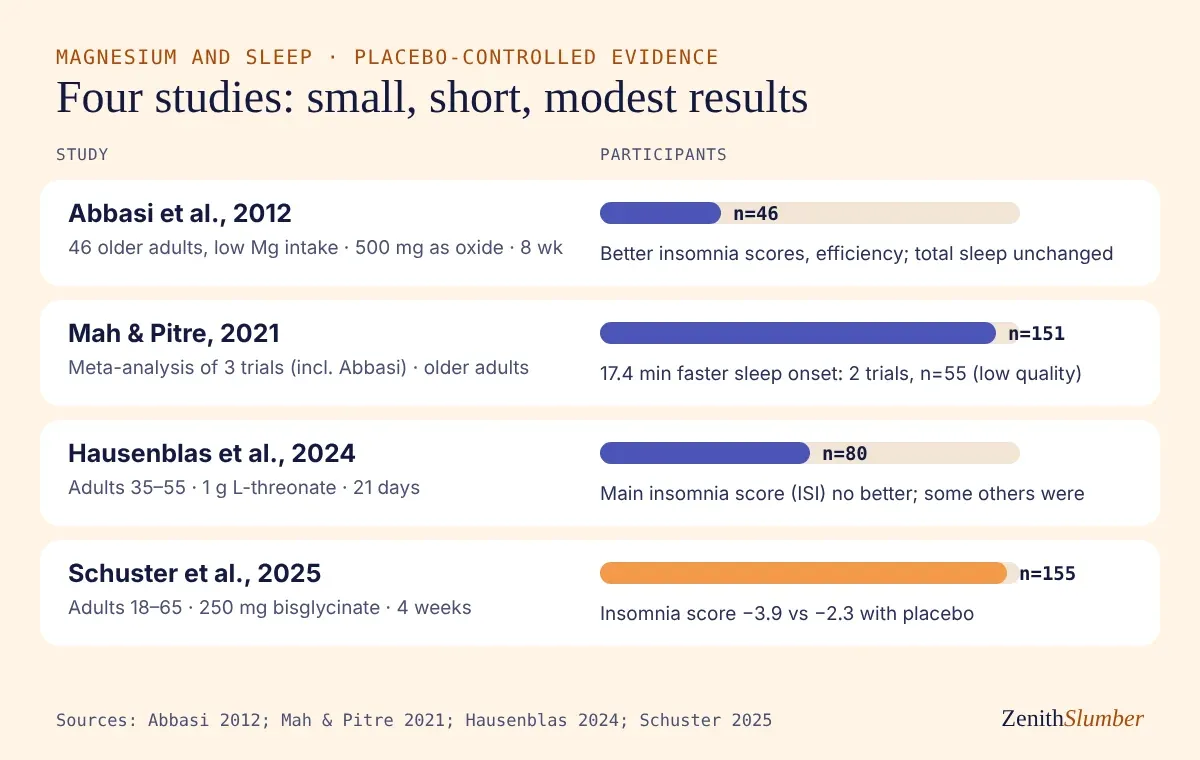
The table below summarises the most relevant placebo-controlled studies, including who paid for them. They differ in who took part, which form of magnesium was used and how sleep was measured, so they cannot simply be added together.
| Study | Who took part | What they took | How long | Main finding | Funding |
|---|---|---|---|---|---|
| Abbasi et al., 20126 | 46 adults aged 60–75 with insomnia, low dietary magnesium and a BMI of 25–34.9 | 500 mg elemental magnesium as magnesium oxide | 8 weeks | Better insomnia scores, sleep efficiency and time to fall asleep vs placebo; total sleep time not significantly different | National nutrition research institute |
| Mah & Pitre, 2021 (meta-analysis)1 | 151 older adults across 3 trials, including Abbasi 2012 (sleep-onset result: 2 trials, 55 people) | Oral magnesium vs placebo | 20 days to 8 weeks | Fell asleep 17.4 minutes sooner; total sleep time gain of 16 minutes was not statistically significant | None reported |
| Hausenblas et al., 20247 | 80 adults aged 35–55 with sleep complaints | 1 g/day magnesium L-threonate | 21 days | No difference vs placebo on the insomnia score (ISI), one of its primary measures; better results on a few items of the other sleep questionnaires and some wearable sleep scores | AIDP Inc. (company) |
| Schuster et al., 202523 | 155 adults aged 18–65 with poor sleep | 250 mg elemental magnesium as bisglycinate | 4 weeks | Insomnia score fell by 3.9 points vs 2.3 with placebo; a modest difference | University; product made by Biogena |
How strong is this evidence?
Not very, yet. The 2021 meta-analysis found that all included trials had moderate-to-high risk of bias and concluded that the literature is not good enough for doctors to make confident recommendations18. A separate 2023 systematic review reached a similar view: observational studies link better magnesium status with better sleep, but the randomized trials show an uncertain effect9.
The 2025 bisglycinate trial is the largest so far, and its result was positive but small. The difference from placebo only just reached statistical significance3, and sleep was measured by questionnaire rather than in a sleep lab. The authors themselves call for studies with objective sleep measurements2.
That is why we label magnesium’s evidence as Limited: the direction is encouraging, the size of the effect is modest, and the studies are small.
Who is most likely to benefit?
Two groups stand out.
- People who don’t get enough magnesium from food. In the 2025 trial, an exploratory analysis hinted that people reporting lower dietary magnesium improved more, but intake was measured with a single unvalidated question2. The positive 2012 trial enrolled only people with low magnesium intake6. This is common. Based on national survey data, 48% of Americans get less magnesium from food and drinks than the estimated average requirement4.
- Older adults with insomnia. The clearest positive trial was done in this group6, and older men are among those most likely to have low intakes4.
If your diet is already rich in nuts, seeds, legumes and whole grains, a supplement may make little difference. It is not a substitute for treating chronic insomnia. For chronic insomnia, the American Academy of Sleep Medicine strongly recommends cognitive behavioral therapy for insomnia (CBT-I)11.
Which type of magnesium is best for sleep?
There is no head-to-head trial comparing forms for sleep, so anyone naming a single “best” type is going beyond the data. What we do know:
- Absorption differs by form. Magnesium aspartate, citrate, lactate and chloride tend to be absorbed better than oxide and sulfate, although this comes from small studies4.
- Glycinate (bisglycinate) has the largest recent sleep trial behind it2.
- L-threonate has been studied for sleep in a smaller, shorter trial that found no difference on its main insomnia score7.
- Oxide is common but less soluble, so less of it is absorbed4.
We compare the forms in detail, including what to look for on a label, in our guide to magnesium glycinate for sleep.
How much magnesium do studies use, and what is the safe limit?
We do not give personal dosing advice, but here are the reference numbers you need to talk it through with a pharmacist or doctor.
- Recommended daily intake from all sources is 310–420 mg for adults, depending on age and sex5.
- Tolerable upper limit for supplements is 350 mg a day for adults. This limit applies to magnesium from supplements and medicines, not food, and was set mainly because higher doses can cause diarrhea510.
- Doses in sleep trials: 250 mg of elemental magnesium as bisglycinate2, and 500 mg of elemental magnesium as magnesium oxide6, which is above the 350 mg supplemental upper limit. The L-threonate trial used 1 g of the compound daily, which contains much less elemental magnesium7.
Labels can be confusing: a capsule may list the weight of the whole compound rather than the elemental magnesium it contains. Always check the “elemental magnesium” line.
When should you take it?
Timing has not been tested head to head in sleep trials. Many people take magnesium in the evening as part of a wind-down routine, which is reasonable, but there is no good evidence that a particular hour matters. If you take certain medications, timing does matter for absorption (see below).
Who should be careful
Who should be careful
- Kidney disease: the kidneys clear excess magnesium. People with reduced kidney function should not take magnesium supplements without medical advice4.
- Certain antibiotics: magnesium can bind tetracyclines and quinolones. Separate them by at least 2 hours before or 4 to 6 hours after magnesium4.
- Osteoporosis drugs (bisphosphonates): magnesium can reduce their absorption; separate them by at least 2 hours4.
- Diuretics and long-term acid reducers (PPIs) can change magnesium levels; ask your doctor before adding a supplement4.
- Pregnancy, breastfeeding, children: talk to a clinician first.
- Digestive side effects: high intakes from supplements and medicines can cause diarrhea, nausea and abdominal cramping5.
Food sources of magnesium
Food is the safest way to raise your intake, and there is no upper limit for magnesium that occurs naturally in food5.
| Food | Serving | Magnesium |
|---|---|---|
| Pumpkin seeds, roasted | 1 oz (28 g) | 156 mg |
| Chia seeds | 1 oz (28 g) | 111 mg |
| Almonds, dry roasted | 1 oz (28 g) | 80 mg |
| Spinach, boiled | ½ cup | 78 mg |
| Cashews, dry roasted | 1 oz (28 g) | 74 mg |
| Peanuts, oil roasted | ¼ cup | 63 mg |
| Black beans, cooked | ½ cup | 60 mg |
| Edamame, cooked | ½ cup | 50 mg |
| Brown rice, cooked | ½ cup | 42 mg |
| Plain low-fat yogurt | 8 oz | 42 mg |
Source: NIH Office of Dietary Supplements4.
A small handful of pumpkin seeds at dinner provides more magnesium than many capsules. For ideas that also fit an evening routine, see our guide to foods that help you sleep.
The bottom line
Magnesium is not a sleeping pill. The best current evidence suggests a small benefit, mostly in falling asleep faster; people with low dietary magnesium may benefit more, but that is not yet proven. Start with food. If you consider a supplement, stay within the 350 mg supplemental upper limit unless a clinician advises otherwise, check your medications, and give it a few weeks before judging; our label checklist for magnesium glycinate shows what to look for. If poor sleep has lasted months, talk to a doctor about CBT-I.
Frequently asked questions
Does magnesium make you sleepy right away?
Not in the way a sleeping pill does. The trials measured changes over weeks, not the night you take the first dose12.
Can I take magnesium with melatonin?
They work in different ways, and some products combine them, but there is little trial evidence on the combination. Melatonin is a hormone and is prescription-only in some countries, so ask a pharmacist first.
Is it safe to take magnesium every night?
For most healthy adults, supplemental magnesium within the 350 mg upper limit is considered unlikely to cause harm5. People with kidney disease or on interacting medications should check with a clinician4.
Is magnesium glycinate better than magnesium citrate for sleep?
No study has compared them directly for sleep. Glycinate has the most recent sleep trial2; citrate is among the better-absorbed forms4. At higher supplemental doses, any form can cause diarrhea10.
Sources (11)
- Mah J, Pitre T. Oral magnesium supplementation for insomnia in older adults: a systematic review & meta-analysis. BMC Complement Med Ther. 2021;21:125. https://pubmed.ncbi.nlm.nih.gov/33865376/
- Schuster J, Cycelskij I, Lopresti A, Hahn A. Magnesium bisglycinate supplementation in healthy adults reporting poor sleep: a randomized, placebo-controlled trial. Nat Sci Sleep. 2025;17:2027–2040. https://pmc.ncbi.nlm.nih.gov/articles/PMC12412596/
- Same trial, results summary. https://www.tandfonline.com/doi/abs/10.2147/NSS.S524348
- NIH Office of Dietary Supplements. Magnesium: Fact Sheet for Health Professionals. https://ods.od.nih.gov/factsheets/Magnesium-HealthProfessional/
- NIH Office of Dietary Supplements. Magnesium: Fact Sheet for Consumers. https://ods.od.nih.gov/factsheets/Magnesium-Consumer/
- Abbasi B, et al. The effect of magnesium supplementation on primary insomnia in elderly: a double-blind placebo-controlled clinical trial. J Res Med Sci. 2012;17(12):1161–1169. https://pmc.ncbi.nlm.nih.gov/articles/PMC3703169/
- Hausenblas HA, et al. Magnesium-L-threonate improves sleep quality and daytime functioning in adults with self-reported sleep problems: a randomized controlled trial. Sleep Med X. 2024;8:100121. https://pubmed.ncbi.nlm.nih.gov/39252819/
- Mah & Pitre 2021, full text. https://www.ncbi.nlm.nih.gov/pmc/articles/PMC8053283/
- Arab A, et al. The role of magnesium in sleep health: a systematic review of available literature. Biol Trace Elem Res. 2023;201(1):121–128. https://pubmed.ncbi.nlm.nih.gov/35184264/
- Costello R, et al. Perspective: call for re-evaluation of the tolerable upper intake level for magnesium supplementation in adults. Adv Nutr. 2023;14(5):973–982. https://pmc.ncbi.nlm.nih.gov/articles/PMC10509448/
- Edinger JD, et al. Behavioral and psychological treatments for chronic insomnia disorder in adults: an American Academy of Sleep Medicine clinical practice guideline. J Clin Sleep Med. 2021;17(2):255–262. https://pubmed.ncbi.nlm.nih.gov/33164742/