Based on an average 90-minute sleep cycle. Real cycles vary, so treat these as a starting point. Adults are advised to get 7 or more hours of sleep a night. Not medical advice.
Enter the time you need to wake up and the calculator suggests bedtimes that let you complete whole sleep cycles, with time to fall asleep built in. Or tap “Going to bed now” to see good times to set your alarm.
How the calculator works
During the night you move through non-REM and REM sleep several times, and the stages change as the night goes on: early cycles contain more deep sleep, later cycles more REM12. One full cycle is commonly described as lasting about 90 minutes3.
The calculator counts back from your wake-up time in 90-minute blocks and adds an allowance for falling asleep. The idea is to wake near the end of a cycle, when you are more likely to be in lighter sleep, rather than in the middle of deep sleep.
How much sleep do you need?
For adults aged 18 to 60, the American Academy of Sleep Medicine and Sleep Research Society recommend 7 or more hours per night on a regular basis4. Sleeping less than 7 hours regularly is linked with health problems including weight gain, diabetes, high blood pressure, heart disease and depression5. That’s why the calculator highlights the options that give you 7.5 hours or more.
A few honest caveats
- 90 minutes is an average. Cycle length varies between people and across the night, so treat the suggestions as a starting point.
- Total sleep matters most. Getting enough sleep regularly is more important than hitting an exact cycle boundary4.
- Time to fall asleep varies. The calculator assumes about 15 minutes. If you usually take longer, choose an earlier bedtime.
- Not a medical tool. If you regularly sleep poorly, feel very sleepy during the day or snore loudly, talk to a doctor.
Tips for using your result
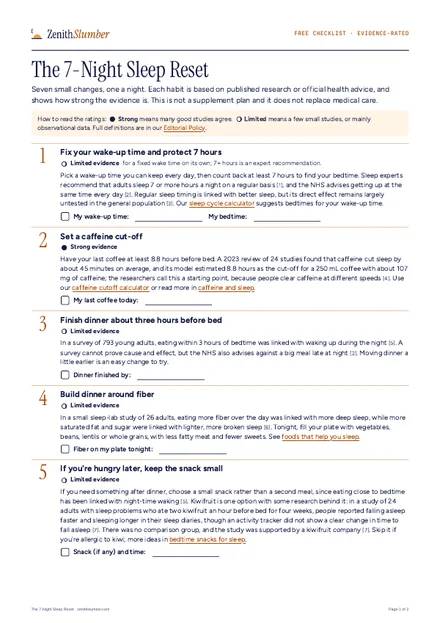
- Pick a bedtime that gives you at least 7 hours and keep it consistent, including at weekends.
- Start winding down 30 to 60 minutes before that time: dim lights, put screens away.
- Check your caffeine timing with our caffeine cutoff calculator.
Sources (5)
- National Institute of Neurological Disorders and Stroke. Brain Basics: Understanding Sleep. https://www.ninds.nih.gov/Disorders/Patient-Caregiver-Education/Understanding-Sleep
- Eunice Kennedy Shriver National Institute of Child Health and Human Development. What happens during sleep? https://www.nichd.nih.gov/health/topics/sleep/conditioninfo/what-happens
- Health library: While you were sleeping (90-minute sleep cycles). https://www.columbushosp.org/health-library/story/a26ab1f8-e9f8-48c6-b078-253209867b39
- Watson NF, et al. Recommended amount of sleep for a healthy adult: a joint consensus statement of the AASM and Sleep Research Society. Sleep. 2015;38(6):843–844. https://pmc.ncbi.nlm.nih.gov/articles/PMC4434546/
- AASM consensus statement, full text. https://www.aasm.org/resources/pdf/adultsleepdurationconsensus.pdf